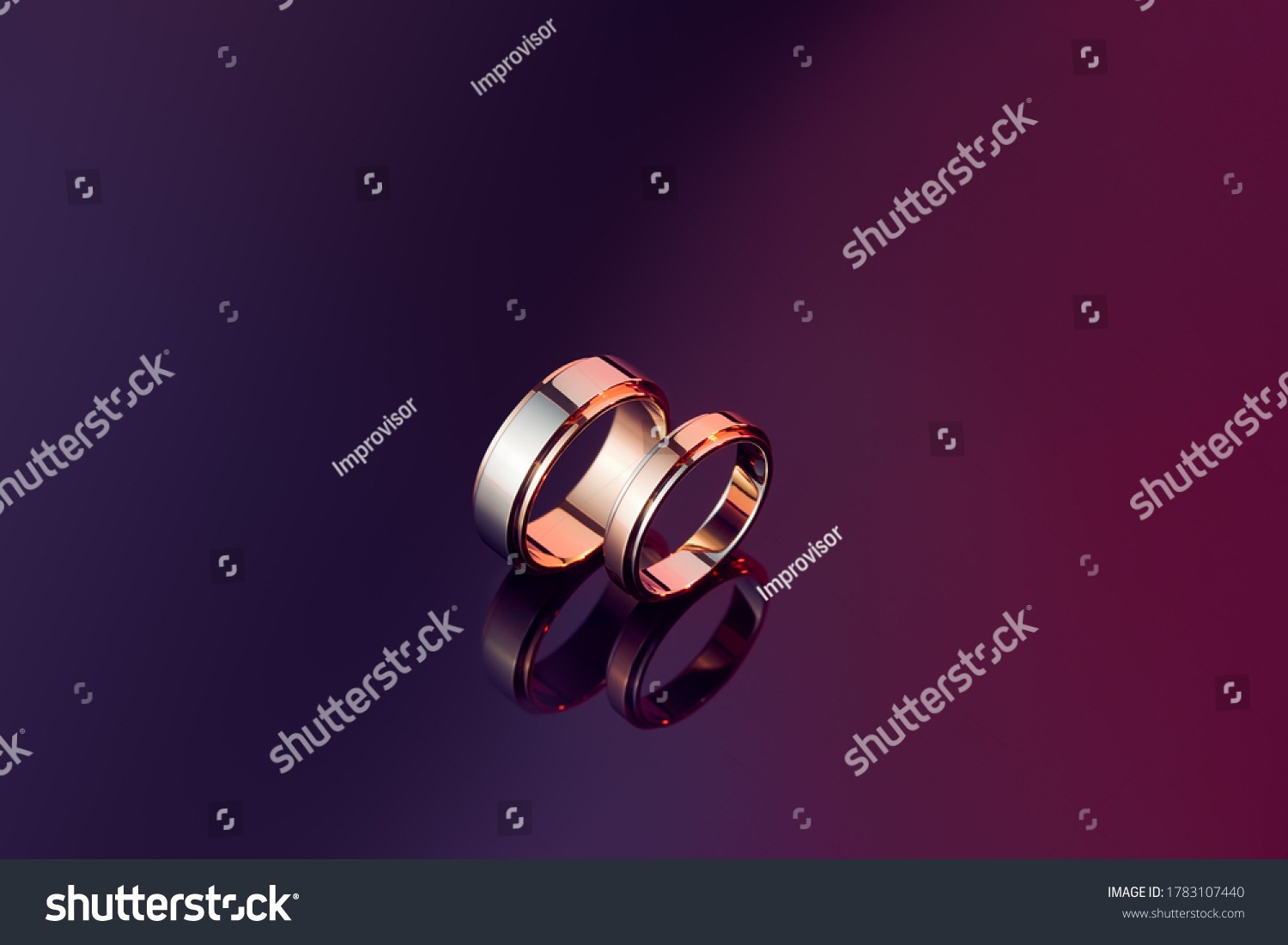
You’re standing at a jewelry counter, and the salesperson slides a velvet tray toward you. On it sits a pair of rings that look exactly alike, just scaled to different sizes. It's the classic "his and hers" approach. But honestly? Most couples today are realizing that male female wedding rings don’t actually have to match. At all.
Choosing rings is stressful. It’s a piece of metal you’re supposed to wear for the next fifty years. That’s a long time to commit to a design just because it "goes with" what your partner is wearing. The tradition of perfectly synchronized sets is a relatively modern invention, fueled more by 20th-century marketing than ancient custom. If you want a heavy, brushed tungsten band and she wants a delicate, rose gold pavé ring, that’s fine. It’s more than fine—it’s actually what most jewelers are seeing in 2026.
The Myth of the Perfectly Matched Set
For a long time, the jewelry industry pushed the idea that a unified marriage required unified jewelry. It made sense for manufacturing. Casting two rings in the same style was efficient. But look back at history. In many cultures, only the woman wore a ring. Men didn't widely start wearing wedding bands in the United States until World War II, when soldiers wore them as a memento of their wives back home. Because the men’s rings were a later addition, they were often utilitarian and plain, while women's rings remained ornamental.
The concept of male female wedding rings as a "set" is basically a branding win from the 1950s.
Today, the "coordinated" look is replacing the "identical" look. You might choose the same metal—say, 18k yellow gold—but different widths and textures. Or maybe you both choose a hidden engraving that only the two of you know about. This allows for individual personality while still keeping a "thread" of connection between the two pieces. Personal style matters. If he works in construction, a soft 24k gold ring is going to be unrecognizable in six months. He needs something like cobalt or tantalum. If she’s a surgeon, a high-profile diamond might snag on gloves, so she needs a low-set bezel. Forcing these two people into a "matching set" is a recipe for one of them leaving their ring in a bedside drawer forever.
Choosing Metals Without Losing Your Mind
Let’s talk about materials. This is where people get stuck. If you're looking for male female wedding rings, you’ll notice the price gap between "traditional" metals and "alternative" metals is massive.
Gold is the standard. It’s classic. It’s also soft. 14k gold is usually the "sweet spot" for durability because it’s alloyed with more copper or silver than 18k. Platinum is the heavyweight champion—literally. It’s denser and heavier than gold, and it doesn't wear away over time; it just moves. Jewelers call this a "patina." When you scratch platinum, the metal is just displaced, not lost.
Then you have the newcomers. Tantalum is becoming huge. It’s a rare, blue-grey metal that is incredibly heavy and scratch-resistant. It feels expensive because of the weight, but it’s often a fraction of the price of platinum.
- Tungsten: Basically indestructible, but it can’t be resized. If you gain weight or your knuckles swell with age, you have to buy a new one.
- Titanium: Light as a feather. Great for guys who hate wearing jewelry.
- Silicone: The "gym ring." Not a primary choice for most, but essential for active lifestyles.
Mixing metals between partners is actually a smart move. It acknowledges that your skin tones are different. A pale skin tone might look washed out by yellow gold but pop against white gold or platinum. A darker or olive skin tone often looks incredible with the warmth of rose gold. Why compromise on what looks good on your hand just to match someone else’s?
The Comfort Fit Revolution
People obsess over the look of the ring, but they forget about the inside. If you’re looking at male female wedding rings, you need to ask about the "Comfort Fit."
Traditional rings are flat on the inside. A "Comfort Fit" ring is domed on the inside. This means less of the metal actually touches your skin. It slides over the knuckle easier. It doesn't trap moisture against your skin as much, which prevents that weird "wedding ring rash" (contact dermatitis) that people get from soap buildup under the band.
Seriously. Try both on. The difference is night and day.
Width and Proportion
Width is measured in millimeters. Most men land somewhere between 6mm and 8mm. Women’s bands are typically 2mm to 4mm.
If you have short fingers, a wide 8mm band will make your hand look like a LEGO hand. It’s too much. If you have long, slender fingers, a 2mm band might look like a piece of wire. There is a sweet spot for every hand shape. Don't just order online based on a picture of a hand that looks nothing like yours. Go to a shop. Try on a "dummy" set of sizers. Move your hand. Make a fist. Type on your phone. If the ring digs into your adjacent fingers, it’s too wide.
Lab-Grown vs. Mined Diamonds in Wedding Bands
The debate is over. Lab-grown diamonds are chemically, physically, and optically identical to mined diamonds. The only difference is the price tag and the origin. In the context of male female wedding rings, specifically those with "eternity" styles (diamonds going all the way around), lab-grown stones allow you to get much higher quality for way less money.
A "natural" diamond ring might force you to settle for "I1" clarity—which means you can see the spots with your naked eye—just to stay on budget. With lab-grown, you can usually jump up to "VS" or "VVS" clarity and "F" or "E" color.
Some people still want the "story" of a mined diamond. That’s a personal value judgment. But from a purely aesthetic and durability standpoint, a diamond is a diamond. If you're looking for stones in a men’s band, they’re usually "flush set" or "channel set" to protect them from impact. Women’s bands often use "prong" settings, which let in more light but are more fragile.
Maintenance: The Part Nobody Mentions
White gold isn't actually white. It’s naturally a yellowish-grey. To make it look like that bright, chrome-white you see in the store, it’s plated in a metal called Rhodium.
Over time, that plating wears off. Your ring will start to look "warm" or yellowish on the bottom. To keep it bright, you have to get it re-plated every 12 to 24 months. If you hate the idea of "maintenance" for your jewelry, don’t buy white gold. Buy platinum or a natural unplated white gold (which has a beautiful, moody grey tone).
Check your prongs. If you have stones in your wedding rings, they need to be checked by a professional once a year. Metal wears down. Prongs snag on sweaters and pull open. A $50 "check and polish" is a lot cheaper than replacing a lost one-carat stone.
Real-World Pricing Truths
How much should you actually spend? The "two months' salary" rule was an ad campaign by De Beers in the 1930s. It’s not a law. It’s not even a good suggestion.
In 2026, the average couple spends roughly $600 to $1,500 on the groom’s band and $1,000 to $3,000 on the bride’s band (depending on the number of diamonds). However, you can find incredible titanium or tungsten bands for under $200. Don't go into debt for a circle of metal. The ring is a symbol, not a financial collateral for your love.
Practical Next Steps for Your Search
Stop looking at Pinterest boards for a second and do these three things:
1. Determine your "Activity Level": If you work with your hands, lift weights, or garden, rule out thin bands and soft stones (like opals or emeralds) immediately. Stick to 14k gold, platinum, or alternative metals.
2. Get sized by a professional in the afternoon: Your fingers swell throughout the day. If you get sized at 9:00 AM when it's cold, the ring will be too tight by 4:00 PM. A professional jeweler will have "thin" sizers and "wide" sizers—use the one that matches the width of the ring you actually want.
3. Decide on your "Connection Thread": If you aren't getting matching rings, pick one element to tie them together. It could be the same metal, a similar engraving, or even just a shared "vibe" (like both being matte finished). This keeps them feeling like a pair without being clones.
4. Check the return policy: Especially for alternative metals like tungsten or wood-inlay rings. These cannot be resized. If you order the wrong size and the company doesn't offer exchanges, you've just bought a very expensive paperweight.
Forget the rules about what "wedding rings" are supposed to look like. Buy the ring you actually want to wear. If that means his is black zirconium and hers is vintage filigree gold, go for it. The only person who has to look at it every day is you.